

If you’re a manufacturer selling to large enterprises with SBTi commitments or CSRD requirements, the time has come: you need to start offering PCFs to remain competitive. To show progress on and reduce scope 3 supply chain emissions, large enterprises are adding product-level emissions disclosure to their supplier requirements.
Skip the PCF process, and you’re putting deals on the line. Because even if you don’t sell to big companies, it’s possible your customers or prospects do, and they will find themselves downstream of reporting requirements. Missing PCF data is about to become an easy disqualification criteria, or a reason to lower unit pricing, for otherwise eligible suppliers.
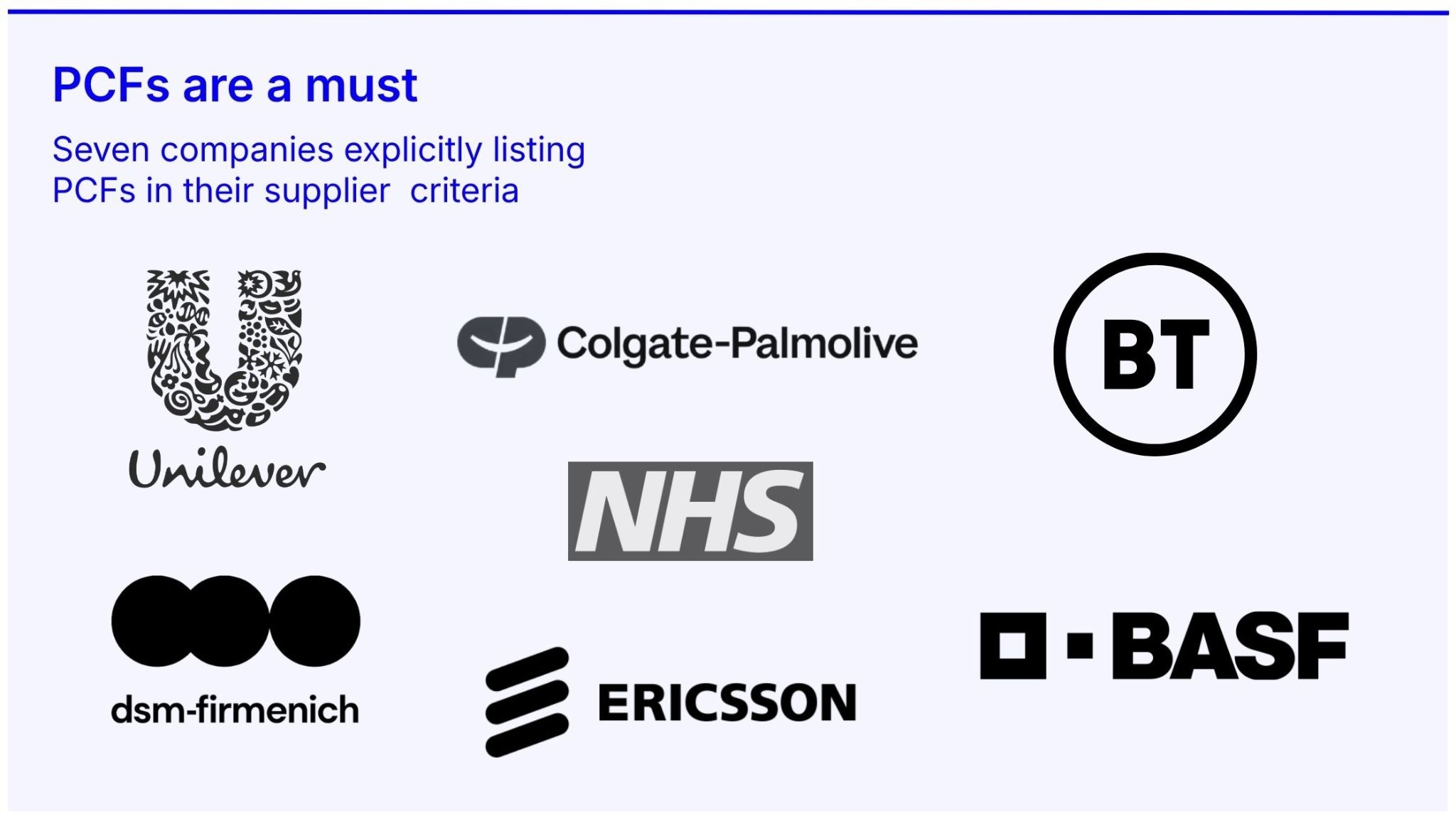
You don’t have to just take our word for it: here’s a list of seven companies already publicly listing PCFs amongst their supplier selection criteria.
BT has been one of the more aggressive movers among telecoms when it comes to climate strategy. It brought its own net zero target forward from 2045 to 2030 for operational emissions, with a 2040 target for supply chain and customer emissions.
What they say on PCFs: "Where applicable, suppliers should also be able to provide product level emission via LCA (Life-cycle Assessments) or PCF (Product Carbon Footprint) (as guided by ISO 14040 and ISO14067 standard) to BT on request." Read more here
The company has SBTi targets set from October 2024: net zero across the value chain by 2045, with a 42% cut to scope 1 and 2 emissions and a 25% cut to scope 3 by 2030.
What they say on PCFs: "Suppliers that contribute significantly to our Scope 3 emissions are asked to share their Product Carbon Footprint (PCF) data with us and to develop a product roadmap aligned with our near-term target of a 25% reduction in greenhouse gas (GHG) emissions by 2030." Read more here
As a public health system rather than a corporation, NHS England's climate strategy runs through its Greener NHS programme. This lists net zero for the NHS's own direct emissions by 2040, and net zero for its wider supply chain and indirect emissions by 2045.
What they say on PCFs: "From April 2028: New requirements will be introduced overseeing the provision of carbon footprinting for individual products supplied to the NHS." Read more here
Ericsson's own target is net zero across its full value chain by 2040, with a nearer-term SBTi-validated goal of halving emissions by 2030. This joint letter is a coordinated move by the UK's ten largest digital connectivity companies agreeing shared minimum supplier standards, which is a rare example of competitors aligning on a climate ask.
What they say on PCFs: suppliers should "...implement Life Cycle Assessments or Product Carbon Footprints in accordance with ISO...for relevant goods they supply." Read more here
Colgate's climate targets are SBTi-approved and structured around net zero by 2040, with 2030 interim goals to cut both scope 1 and 2 and scope 3 (purchased goods and services) by 42% against a 2020 baseline. Supplier engagement is positioned as one of the most material levers in its whole climate strategy.
What they say on PCFs: “The sourcing of our ingredients and packaging accounts for about 80% of Colgate’s Purchased Goods and Services emissions...our climate engagement efforts are helping suppliers innovate to provide us with lower-emissions ingredients and packaging, as well as carbon footprint data." Read more here
The world's largest chemical producer by revenue, BASF targets net zero (scopes 1 and 2) by 2050, with an interim goal of a 25% emissions cut by 2030 against a 2018 baseline.
What they say on PCFs: "In our Supplier CO2 Management Program we work together with our suppliers to create transparency on the Product Carbon Footprint (PCF) of our purchased raw materials..." Read more here
Unilever's climate strategy targets net zero across scope 1, 2, and 3 by 2039, which is earlier than most peers. They also have a near-term 2030 goal to eliminate scope 1 and 2 emissions entirely and cut scope 3 energy/industrial emissions by 42%.
What they say on PCFs: "16.2 - Data for GHG reporting: When requested, footprint data for product level GHG emissions for the materials sold to Unilever is shared for use by Unilever in public reporting and to authorities on Unilever's own GHG reduction targets. This should be done via an agreed methodology and include third-party verification." Read more here
When large corporations start making moves, the impacts hit their supply chains quickly and eventually the whole market has to follow. You might think it’s not coming for you, but take note: the companies we speak to are telling us that while their customers “don't insist we should have [PCFs] immediately, they say it will, sooner or later, be a requirement.” And when you’re being compared against a similar supplier who can provide PCF data, guess who wins?
With PCFs, it pays to be prepared. Traditionally, a single PCF can take weeks or even months to calculate. Implementing that across your whole product catalog is going to leave you with a major problem if your customers suddenly start making requests for product-level data. If you get ahead of the curve by calculating now, you can already start winning deals, retaining relationships, and protecting your margins with the customers who need PCFs sooner rather than later.
And what better way to get ahead of your peers than with a handy tool to cut the workload? PCF Studio can get you a first estimate in minutes—and your first five PCFs are free. Try PCF Studio here.


.svg)


