

The foundation of any product carbon footprint (PCF) is data—a lot of it. You need to know what materials went into your product, the sourcing locations of each item, how far they traveled to get to your manufacturing site, how much energy was used to create the product… You then need emission factors for each activity to convert the data you’ve collected into an emissions estimate.
The problem is that all that data takes a huge amount of time to collect—if that’s possible at all, because data is usually siloed. Attempts to engage suppliers usually come up empty. These problems only compile across an entire product catalog of hundreds or thousands of products; the data collection nightmare spirals.
But what most companies get wrong is thinking they need primary data for PCFs. As our external verification partners at SustainCERT said: “you don’t need perfect data to get through a [PCF] verification … The better question is can you justify and defend your choices?” With that in mind, let’s look at the different kinds of data you might source to calculate PCFs, and what data you actually need.
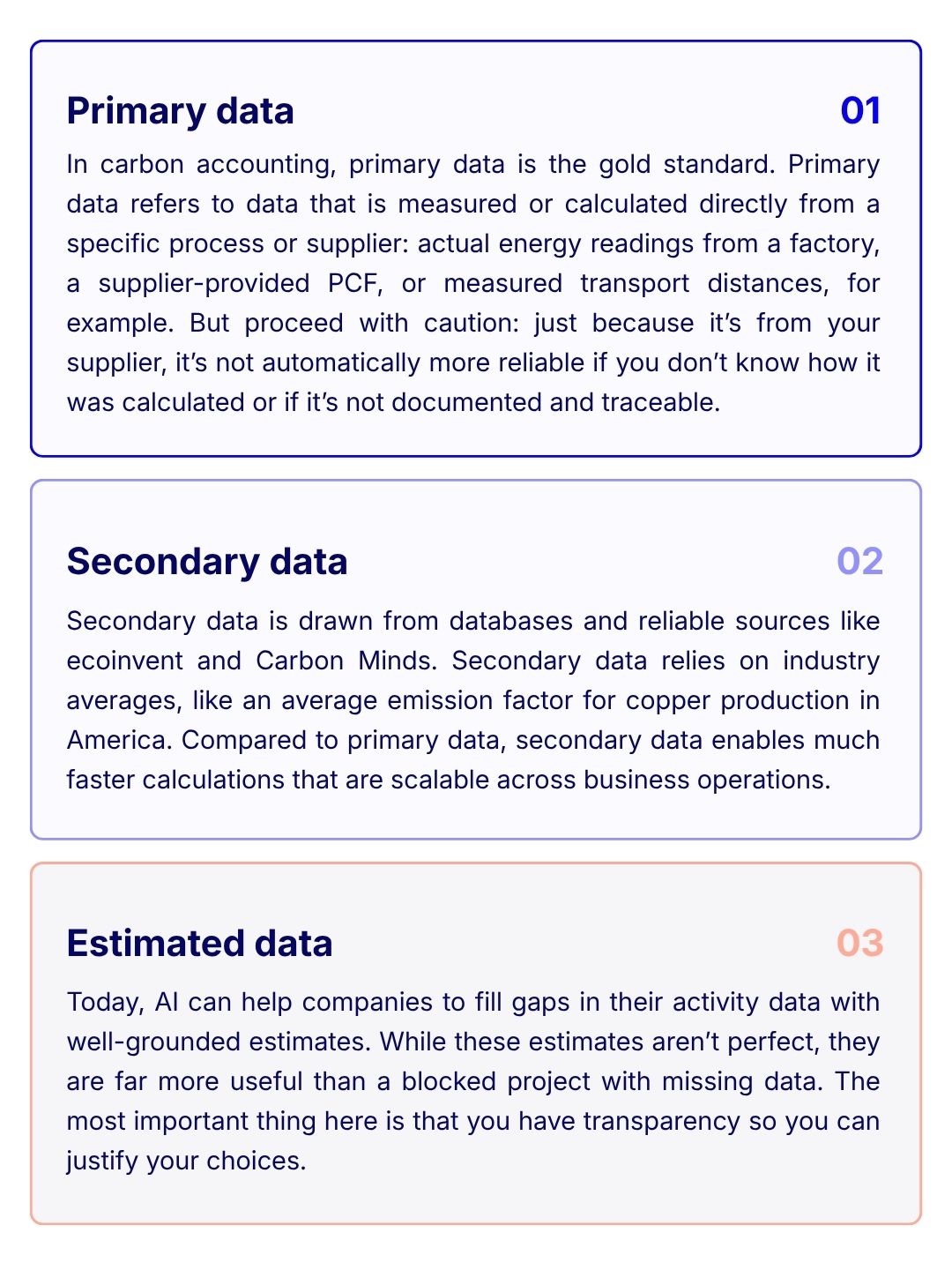
In carbon accounting, primary data is the gold standard. Primary data refers to data that is measured or calculated directly from a specific process or supplier: actual energy readings from a factory, a supplier-provided PCF, or measured transport distances, for example. But proceed with caution: just because it’s from your supplier, it’s not automatically more reliable if you don’t know how it was calculated or if it’s not documented and traceable.
Primary data yields more accurate PCFs but it is very difficult, time-intensive, and costly to collect. Most companies can’t simply stroll into a power station and collect energy readings. That’s why secondary data is much more common, and why the vast majority of PCFs are a mix of the two. Even the supplier-provided PCF you receive is likely part calculated using secondary data.
The Partnership for Carbon Transparency (PACT)—the global initiative established for standardizing the calculation of PCFs—captures this nuance through data quality indicators (DQIs), which are a set of scores covering how representative the underlying data is for your specific product, supplier, and time period. The point isn’t to chase a perfect “100% primary” score but to understand where your data can be improved. Improving your data is a journey, and there’s no point waiting for perfect data to calculate your first PCF.
Secondary data is drawn from databases and reliable sources like ecoinvent and Carbon Minds. Secondary data relies on industry averages, like an average emission factor for steel production in Europe. Compared to primary data, secondary data enables much faster calculations that are scalable across business operations. The Climatiq database compiles emission factors from secondary data sources so they’re all easily accessible in one place and in a consistent format. Every factor in the database is expressed in a consistent unit, tagged with its source, publication year, geographic region, LCA boundaries, GHG Protocol scope, and IPCC assessment report version. The schema is the same regardless of which source the data came from, meaning you can mix and match factors from a range of providers.
Even then, most companies find they still have gaps in their business activity data. Emission factors are only part of the equation: without granular data covering their business activities, they’re effectively useless. But today AI can help companies to fill gaps in their activity data with well-grounded estimates. While these estimates aren’t perfect, they are far more useful than a blocked project with missing data.
Practical reality: don't wait until you have perfect data to publish your first PCF. Almost every real-world PCF blends all three types. What matters is being explicit about which data is which—so reviewers can see exactly where the precision is, and where the assumptions live.
Most people think they need perfect data to get started calculating PCFs. That’s because historically, data availability has been a major blocker to creating PCFs—especially with legacy tools or consultant templates that demand endless data points to deliver a result. Sustainability managers tell us that “[legacy tools are] just too difficult for what you get out and that's why we've not done it. If you've got the tiniest piece of data missing, it just doesn't work, so the calculation won't run.” But incomplete data is the norm, not the exception. This shouldn’t be an obstacle for making progress on carbon transparency.
PACT says that “waiting for 100% primary, fully-verified PCFs means never starting,” and encourages using partial, estimated data to create product-level emissions estimates. PCF Studio is built around that reality. Unlike traditional tools, whatever data you have available, with PCF Studio you can get a starting point. The more precise your inputs, the more precise the results.
To see how easy it is to get started calculating PCFs (even with limited data), try PCF Studio for free here.


.svg)


